


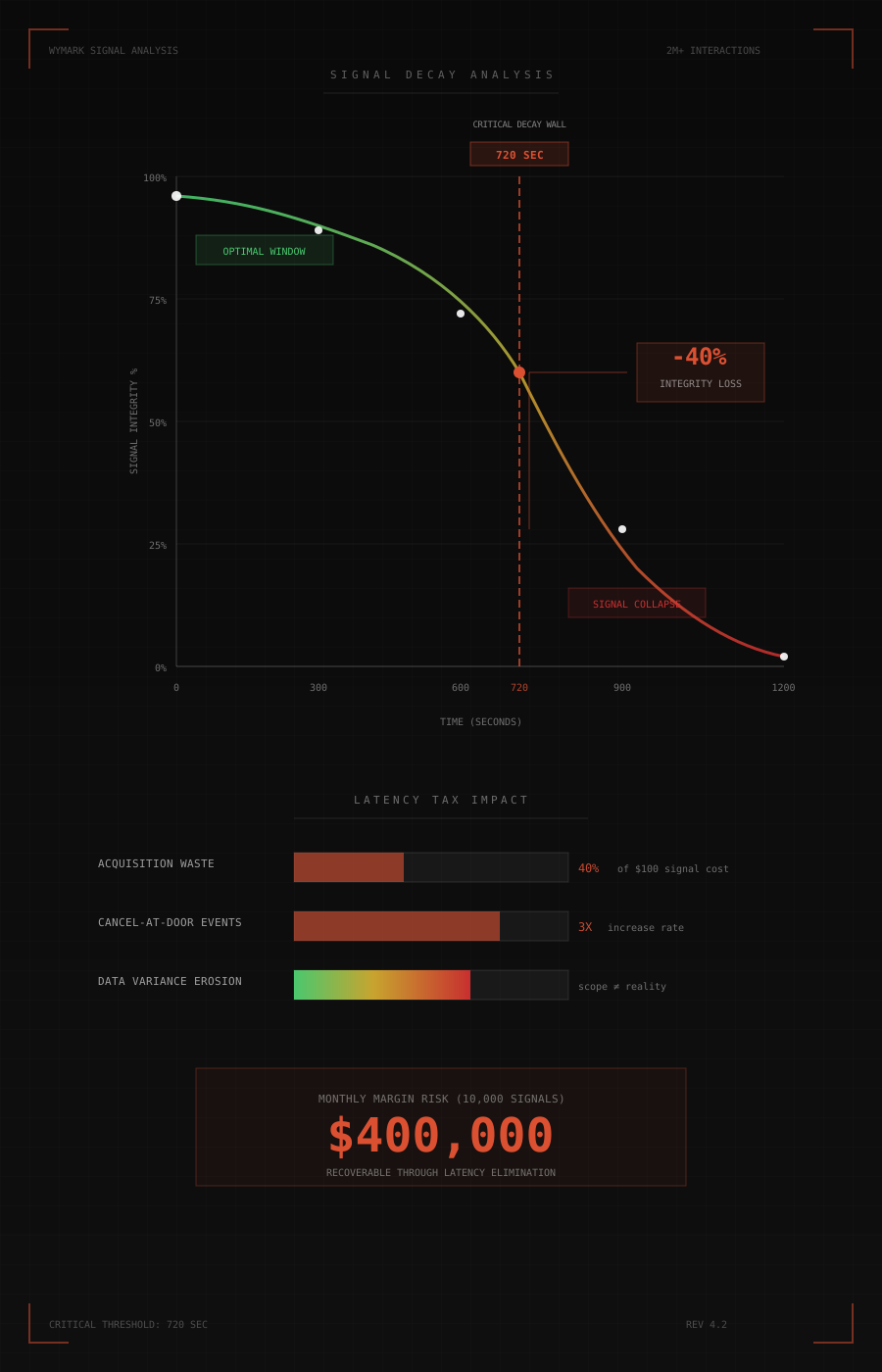
The cost of signal decay: Analyzing the 12-minute window.
Quantifying the Half-Life of Market Intent
In the high-velocity field service environment, an inbound market signal is a volatile commodity that begins a process of rapid degradation the moment it is generated. Wymark’s internal data, pulled from over two million distinct service interactions, identifies a specific "Critical Decay Wall" at exactly 720 seconds. Within this 12-minute window, the synchronization between a customer’s immediate requirement and your field capacity is at its peak. Once this temporal threshold is crossed, the systemic integrity of the signal collapses, resulting in a 40% reduction in successful field deployments. This is not merely a service failure; it is an infrastructure failure where the "plumbing" of the organization cannot move the signal fast enough to prevent its total loss.
Mechanics of the Latency Tax
Most enterprise partners unknowingly operate under a "Latency Tax"—a hidden operational cost caused by batch-processing and manual verification. When a market signal is captured but sits in an administrative queue for "review," it enters a state of signal stagnation. During this stagnation, the market intent is not static; it is actively eroding as the customer’s availability shifts or as competitors with higher-frequency systems capture the demand.
The fiscal weight of this tax can be mapped across the enterprise:
- Acquisition Waste: If your system investment costs $100 to capture a signal, but your dispatch delay exceeds 15 minutes, you are effectively burning 40% of that capital on a signal that has already decayed.
- Resource Misalignment: Delayed signals result in a 3x increase in "cancel-at-door" events, where a technician arrives to find the customer has moved on, wasting fuel, labor, and truck-time.
- Data Variance Erosion: The longer a signal stays in the queue, the higher the likelihood of data drift—where the initial service scope no longer matches the field reality upon arrival.

Automated Synchronization vs. Administrative Friction
To bypass the 12-minute decay wall, Wymark’s architecture removes every human intervention point between the market signal and the technician’s dispatch queue. Our infrastructure replaces the "dispatch office" with an automated synchronization layer that processes demand signals in milliseconds. By moving to a machine-first orchestration model, enterprise partners can maintain 99.9% dispatch integrity even during high-volume seasonal spikes.
This high-frequency engine enforces three primary protocols:
- Immediate Signal Normalization: Raw demand packets are instantly stripped of noise and converted into deterministic dispatch commands.
- Algorithmic Governance: Pre-defined rules validate geographic coordinates and technician licensing without requiring a human signature.
- Direct-Queue Injection: Validated signals bypass the administrative desk and are injected directly into the technician's mobile workflow to ensure the 720-second window is never breached.
The Structural Impact on Profit Margin
For a national fleet of 10,000 monthly signals, the 12-minute decay window represents a $400,000 monthly margin risk. Organizations that view their acquisition layer as a slow-moving, manual queue are effectively subsidizing the growth of their more efficient competitors. Wymark’s research concludes that speed is not a secondary benefit—it is the primary governor of field density and profitability. By reclaiming the "Latency Tax," partners can effectively triple their revenue-to-acquisition ratio without increasing their total workforce. The goal of a modern service enterprise must be the total elimination of signal stagnation, turning the acquisition layer into a high-pressure pipe that delivers demand to the field with zero friction.
Operational Authority and System Trust
There is a psychological component to this infrastructure. In the home service sector, a rapid response within the critical window establishes what we define as Operational Authority. A customer who receives a dispatch confirmation in seconds perceives a higher level of technical competence than one who waits for a 4-hour "callback". This trust is the byproduct of a system that treats time as a rigid technical constraint. By building your infrastructure to honor the 12-minute window, you aren't just improving a metric; you are building a resilient, high-capacity engine that dominates its market through sheer operational speed.
